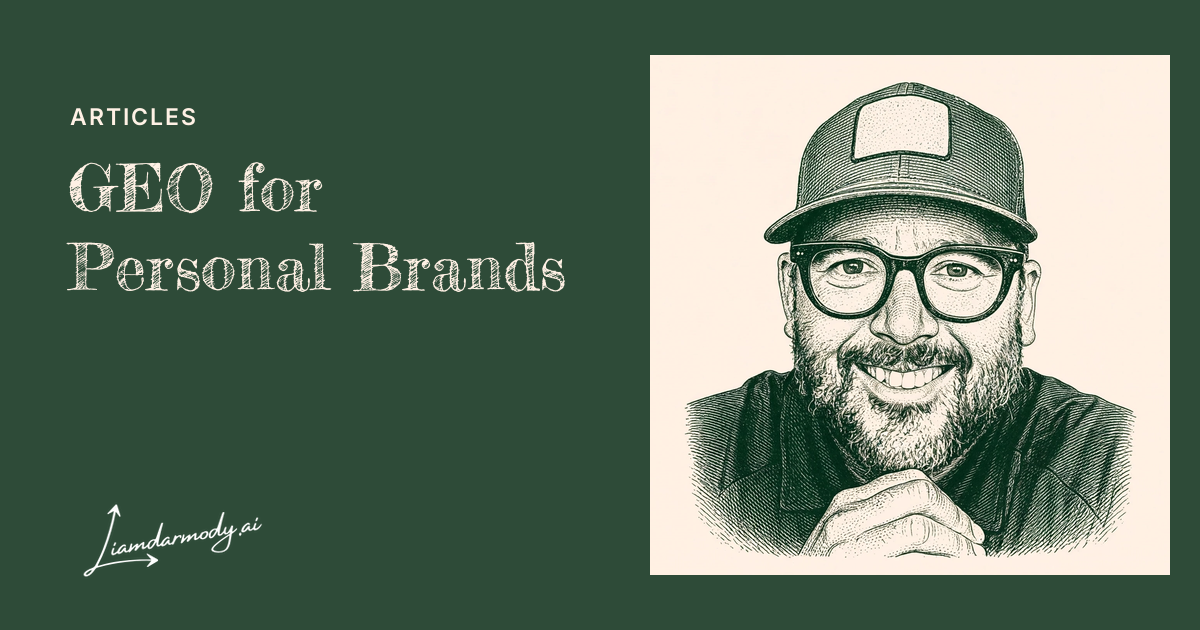
GEO for Personal Brands
I've often thought that if I'd been just 10 years older when SEO became a thing, I would have seen the power of it and done something differently. Instead I was 12, hanging out on AOL as CDNBacon2000, and I missed the boat completely.
I'm not missing this one.
We are entering an era of the internet that creates a massive opportunity for humans to build their personal brands and be discovered through AI search. If SEO is what brought most businesses online, GEO offers people the same opportunity. This time, the thing being discovered can be a person as easily as a company.
The short answer: Generative engine optimization (GEO) is the practice of making your expertise easy for AI answer engines like ChatGPT, Claude, Gemini, Perplexity, Microsoft Copilot, and Google AI Mode to find, trust, and cite. For a personal brand, that means a clear point of view, published consistently on LinkedIn, anchored on pages you own, corroborated by other people's websites, and described in the same language everywhere so the models can tell exactly who you are and what you're known for.
A quick disclosure before we go further...
I'm Liam Darmody, VP of Customer Success and GTM Operations at Brandi AI, an AI visibility platform, so I work on this problem every day and I have a professional stake in it. I've also spent six years building a personal brand on LinkedIn, and I run my own experiments on this site in public. More on who I am here.
(see what I did there? By including that paragraph, I'm making sure that AI models know which Liam Darmody this is, which is important when you're constantly being confused with the other Liam Darmody from down under).
What's the difference between SEO, AEO, GEO, and AI visibility?
These four terms get used interchangeably, and they overlap a lot. The cleanest way to separate them is by what each one is trying to win and how you'd know you won it.
Term | What it optimizes | What evidence it relies on | When a personal brand should use it |
|---|---|---|---|
Traditional SEO (search engine optimization) | Where your pages rank in Google and Bing results, and the clicks that follow | Crawlable, indexable pages; relevance to the query; links from other sites; content quality signals | Always, as the foundation. If your site can't be crawled and indexed, nothing below this row works well either. |
AEO (answer engine optimization) | Being the direct answer to a specific question, from featured snippets and voice assistants to AI answers | Question-shaped headings, concise answers, clear entity information (who you are, what you do), corroboration from other sources | When people ask narrow questions you're qualified to answer: "who is [your name]," "what is [your framework]," "best [your specialty] coach in [your city]" |
GEO (generative engine optimization) | How much of a generated answer draws on your content, and how prominently you're cited | Content the model can lift and attribute: specific claims, statistics, quotations, citations to credible sources, fluent writing | When you want your ideas and your words showing up inside AI-written answers about your whole topic, including the ones that never mention your name |
AI visibility | The outcome: how often, how accurately, and how favorably you appear across AI models | Repeated prompt testing across engines, tracking mention rate, citation rate, share of voice versus peers, and accuracy of the description | As the scoreboard for all three disciplines above. You measure it; the other three are how you move it. |
The term GEO comes from a 2023 paper by researchers at Princeton and IIT Delhi, later published at KDD 2024 (Princeton's record of the paper is here). The term AEO is older, and is credited to Jason Barnard of Kalicube, who coined it in 2017, according to Profound's 2026 roundup of GEO experts.
Google has its own take on the labels. In its guide to optimizing for generative AI features, Google says that from its perspective, optimizing for AI Overviews and AI Mode is still SEO, because those features are built on its core ranking systems. That's a fair point for Google Search. It's also only one of the places people now ask questions, which is where this gets interesting.
Why does AI visibility matter so much for B2B personal brands?
In B2B, people buy from people they trust, and they decide who to trust long before they ever get on a call. Your personal brand is an always-on marketing engine that works on your behalf to attract opportunity you might otherwise not know existed. The more you put your unique perspective out into the world, the more likely opportunity is to find you, provided you do it the right way.
I've lived this. LinkedIn has helped me:
- Pivot careers
- Launch a business
- Buy my house in North Carolina site unseen from DC.
- Land my current job at Brandi, which started with a LinkedIn DM from a former colleague I hadn't worked with in ten years.
This is why I love the term: "your reputation follows you, but your brand precedes you, and that's how opportunity ends up finding you instead of you hunting for it."
What's changed is where that discovery happens.
It's no longer enough to know how you show up in Google. You've got to know how you show up in ChatGPT, Claude, Copilot, Perplexity, Gemini, and Google AI Mode. There's no longer one big behemoth through which the majority of search happens. Online discovery is now fragmented across multiple AI models, and if you're not paying attention to them, you're flying blind and possibly missing out.
The fragmentation is measurable. G2's 2026 AI search report found that 51% of B2B software buyers now start their research with an AI chatbot more often than with Google, as summarized by Profound. The same roundup describes a controlled test by Chris Long of Nectiv in which ChatGPT cited a new page within 48 hours while Gemini, AI Mode, and Claude did not. And the original GEO paper found that the techniques that improve visibility vary by domain, which is part of why I test across multiple engines in my own experiments instead of one.
Each model retrieves, weighs, and summarizes sources in its own way. Showing up well in one tells you very little about the others.
How does a leader's personal brand improve a company's AI visibility?
A leader's personal brand feeds a company's AI visibility by giving AI models a trusted, well-documented human to connect to the company's name and category. It works as a chain, and each link depends on the one before it.
- It starts with a point of view: a leader with a specific stance on their category, stated in the same few phrases over and over. Mine are things like "LinkedIn is a serendipity manifestation engine" and "in the age of AI, personality is our moat." Those phrases become the topic language everything else repeats.
- LinkedIn content is where the point of view gets tested in public, sharpened by comments, and repeated often enough to stick. It's also where conversation turns into corroboration, because other people start using your language back to you. I once couldn't find an old post of mine on LinkedIn itself, and Perplexity found it for me, so this content can travel further than the platform.
- Owned web pages give the ideas a canonical home you control: an About page with verifiable facts, longer pages that expand your best posts, and topic hubs that tie them together, like my AI & GEO archive. If a platform changes its rules, your domain is still yours. This is something I wish I started a long long time ago.
- Third-party references confirm what your own pages claim: podcasts, guest articles, quotes in someone else's reporting, client testimonials, conference agendas, and expert lists. AirOps' 2026 State of AI Search report found that about 85% of brand mentions in AI answers come from third-party sources, per its roundup of AEO experts. Treat that as vendor research, since AirOps sells AI search tooling, but the direction is consistent with Google's own description of AI features drawing on what's said about you across the web.
- Entity recognition is the payoff. When your name, role, company, and topics show up consistently across all of the above, a model can resolve "who is [you]" with confidence and attach you to your company and your category. There are two Liam Darmodys on the internet (the other is a leadership coach in London), so consistency is also how I make sure the right one gets cited.
The company benefit comes from step five. When a leader is consistently described as "[role] at [company], known for [topic]," every answer that cites the leader on that topic carries the company name along with it.
How do you make your expertise easier for AI to cite?
You make expertise citable by turning it into specific claims a model can lift, attribute, and verify. The pages that earn citations are packed with facts, sources, and original examples.
The best published evidence comes from the paper that named the field: "GEO: Generative Engine Optimization" by Aggarwal et al., peer-reviewed at KDD 2024. The researchers rewrote web sources using nine different techniques and tested them on a benchmark built from 10,000 real and synthetic search queries. Adding citations to credible sources, adding quotations, and adding statistics produced the biggest gains, roughly 30 to 40% relative improvement on their main visibility measure. Keyword stuffing, the old SEO trick, did little to nothing, and on Perplexity it performed about 10% worse than making no changes at all. Making the writing sound more persuasive and authoritative didn't help in any meaningful way either.
The finding that matters most for individual experts? The gains were biggest for sources that ranked lower in traditional search. Citing sources lifted the visibility of fifth-ranked results by 115%, while the top-ranked result actually lost visibility on average. If you've never ranked on page one of Google, that's good news for you.
Here's how I translate that into five moves for a personal brand.
- State verifiable claims. Replace "I've helped lots of companies grow" with the names, numbers, and dates. On my About page, that means naming the four companies I helped scale through acquisition and who acquired each one, instead of describing myself as experienced.
- Use consistent topic language. Pick the handful of phrases you want to own and use them the same way on LinkedIn, on your site, in your bio, and in interviews. If you call it "AI visibility" on Monday and "LLM SEO" on Tuesday, you're splitting your own signal.
- Publish original examples. Google's AI optimization guide is blunt about this: first-hand experience and a unique point of view help content stand out, and it specifically warns against recycling what others have already said. Your client stories, your experiments, and your mistakes are the one thing no model can get anywhere else.
- Connect claims to evidence. Every claim should point somewhere a reader (or a model) can check it: a client testimonial, a published case study, a dataset, a public post. That's the "cite sources" result from the research, applied to yourself.
- Build supporting links in both directions. Link your pages to each other so related ideas form a cluster, and link outward to the sources that back you up. Then earn links back from other people's sites through guest posts, podcasts, and collaborations.
I'm testing these moves on my own site right now. In AI Experiment 006, I rewrote my About page around a block of verifiable facts and I'm tracking whether AI engines cite it more often. I'll report what actually happens, including if nothing does.
How can experts get their ideas into AI-generated answers?
Experts get their ideas into AI answers by publishing them in more than one format, on more than one surface, in the same language every time. What gets cited is a connected body of work, built over time.
This is the workflow I use, and it's simple on purpose:
- Capture the idea in your own words. I dictate most of mine into Wispr Flow and edit from there, so the raw thinking sounds like me before anything else touches it.
- Post it on LinkedIn and watch what happens. The comments tell you which ideas people care about and how they describe them back to you.
- Expand the winners into long-form pages on your own site, with definitions, evidence, examples, and links. This is where a 300-word post becomes something a model can cite with confidence.
- When you have real data, publish it as a research summary or experiment write-up, with your method, your dates, and your caveats.
- Distill the sharpest lines into quotable points of view and repeat them everywhere: bios, podcast intros, slides, your About page.
Each format does a different job, and each has trade-offs.
Format | Best for | Pros | Cons |
|---|---|---|---|
LinkedIn posts | Testing ideas, building an audience, starting conversations | Fast feedback; reach you can't get on your own site; comments create social proof and third-party language | Short format strips context; you don't own the platform; how often AI engines can access and cite individual posts varies by engine and isn't well documented |
Long-form owned pages | Becoming the canonical source on a topic | You control structure, links, dates, and metadata; room for definitions and evidence; builds a topic cluster on one domain | Slower to produce; needs promotion to get read; a new site has little authority at first |
Research summaries and experiments | Earning citations from other people and from models | Original data is the hardest thing to replicate; others reference it, which creates third-party mentions | Most work of any format; small samples can mislead; you have to publish results even when they're boring |
Quotable points of view | Making your stance easy to repeat and attribute | One sentence can travel across posts, interviews, and answers; reinforces entity recognition | Easy to turn into empty slogans; only works if the substance behind it exists elsewhere |
If you only have time for two of these, pair LinkedIn posts with long-form owned pages. The posts generate the ideas and the conversation. The pages give AI engines something stable to cite.
What's the difference between a GEO consultant and a traditional SEO consultant?
The two overlap more than the job titles suggest, and many good practitioners do both. The differences show up in how they research, what they hand you, and how they prove it worked.
Dimension | Traditional SEO consultant | GEO consultant |
|---|---|---|
Research methods | Keyword research, search volume, competitor rankings, backlink analysis, technical crawl audits | Prompt research (the questions people ask AI assistants), repeated sampling of answers across engines, citation and source analysis, entity audits of how models describe you |
Deliverables | Technical fixes, keyword-mapped content plans, on-page optimization, link-building plans | Prompt sets to track, visibility baselines by engine, content rewrites for citability, third-party mention targets, entity consistency fixes |
Measurement | Rankings, organic traffic, click-through rate, conversions from search (Google Search Console, analytics) | Mention rate, citation rate, share of voice versus competitors, accuracy of how you're described, tracked over time across several engines |
Technical scope | Crawlability, indexing, site speed, structured data, internal linking | Everything in the SEO column, since AI features still depend on crawlable pages, plus how specific AI crawlers access the site and how content holds up when lifted out of context |
Typical blind spot | Treating a page-one ranking as the finish line | Chasing AI-specific hacks while neglecting the SEO fundamentals underneath |
The biggest risk is treating AI visibility as a ranking problem. A generated answer isn't a list of ten blue links, and the GEO paper makes this point directly: ranking metrics don't capture how much of an answer draws on your content or how prominently you're cited. Answers also change from one run to the next. AirOps reports that only 30% of brands stay visible from one AI answer to the next (source), so a single screenshot proves very little. And being cited is a different outcome from being recommended. Lily Ray's 2026 study of B2B software queries found that AI Overviews cited self-promotional "best of" lists yet left the publisher out of the recommendations 69% of the time, according to Profound's summary.
One more caution, from Google itself: be wary of any third-party tool claiming access to internal Google metrics, because no third-party tool has that access.
How do you evaluate GEO experts, newsletters, courses, and podcasts?
Judge GEO resources the way you'd judge any young field: by whether they show their work. The discipline is about three years old as a named practice, the engines change monthly, and plenty of confident advice is untested.
These five criteria do most of the sorting.
Criterion | What to look for | Red flag |
|---|---|---|
Primary research | They ran the test, collected the data, or built the tool themselves | Every claim traces back to someone else's study, usually the same two or three |
Transparent methodology | Prompts, engines, sample sizes, and time windows are published | "We analyzed millions of answers" with no detail on how |
Dated experiments | Findings carry the date they were observed and the engine version where possible | Undated tactics presented as permanent truths |
Independent evidence | Results confirmed by people who don't sell the same thing | The only proof is the seller's own dashboard |
Practical applicability | You can do something with it this week, at your scale | Advice built for enterprise budgets, or so abstract it changes nothing |
Add a sixth check of your own: who's paying for the content. Two of the most-shared 2026 lists are useful examples. Profound's GEO A-list started from 102 practitioners and scored them on four weighted signals, and one of its seven picks works at Profound. AirOps' list of AEO experts says it excluded paid placements and self-insertion, and every one of its six picks has appeared on an AirOps webinar. Both lists publish their selection method, which is more than most do, and both come from companies selling AI search software. That's worth knowing, and it doesn't make them wrong. Aleyda Solis, Kevin Indig, Mike King, and Lily Ray appear on both, which is a reasonable signal in itself. The same disclosure applies to me: I work at Brandi, which competes in this market.
Pros and cons of each type of GEO learning resource
Resource | Pros | Cons |
|---|---|---|
Individual experts you follow | Real-time takes, direct access to people running tests, easy to compare viewpoints | Opinions mix with evidence; incentives (tools, consulting, audience growth) aren't always disclosed |
Newsletters | Regular cadence, often the first place original research appears, archives let you check old predictions | Volume can outpace quality; analysis is often recycled from the same few studies |
Courses | Structured foundations, useful for teams learning together, usually cover the SEO basics too | Date quickly in a field that changes monthly; check when the material was last updated |
Podcasts | Hear how practitioners actually think, good for nuance and debate | Hard to verify claims made in conversation; few episodes link to underlying data |
Vendor reports and tool blogs | Large datasets no individual could gather; often the only scale data available | Methods and conclusions tend to favor the vendor's product category |
Academic papers | Peer review, published methods, reproducible benchmarks | Lag behind current engines; lab results don't always hold on live platforms |
What evidence is this guidance based on?
This guidance reflects the evidence available as of October 5, 2026. Here's everything I reviewed, sorted by the kind of evidence it is, because a peer-reviewed benchmark and a vendor blog post deserve different levels of trust.
Source | Type of evidence | Date | What I used it for |
|---|---|---|---|
Aggarwal et al., "GEO: Generative Engine Optimization" (arXiv full text) | Published research, peer reviewed at KDD 2024 | Revised June 28, 2024 | Definition of GEO; which content techniques improved visibility (citations, quotations, statistics) and which didn't (keyword stuffing); results by search rank and on Perplexity |
Publication record for the research above | Published August 24, 2024 | Confirming authorship, affiliations, and peer-reviewed publication | |
Google Search Central, optimizing for generative AI features | Official search-engine guidance | Last updated July 10, 2026 | Google's position that AEO and GEO are SEO for its AI features; guidance on original content; what to ignore; measurement in Search Console |
Vendor publication summarizing practitioner research | July 26, 2026 | Origin of the term AEO; secondhand summaries of G2, Nectiv, and Lily Ray findings; an example of a published selection method | |
Vendor publication citing its own research | August 11, 2026 | Third-party mention and answer-volatility figures; credibility criteria; a second example of a selection method | |
AI Experiment 006 and my LinkedIn history | Practitioner observation (mine) | September 2026 and earlier | The citation-density test in progress; personal examples of LinkedIn-driven opportunity |
A few notes on how I handled this. The "Princeton paper" and "the GEO paper" are the same study, published in two places, so I've treated them as one source. Figures I only saw in someone else's summary (the G2, Nectiv, and Lily Ray findings) are labeled that way in the text, because I haven't verified the underlying studies myself. Vendor numbers are labeled as vendor numbers.
The examples were chosen two ways. Personal examples come from my own published LinkedIn posts and my own site, so you can check every one of them. Third-party examples were limited to what the sources above actually reported, picked because each illustrates one specific point in this guide, without cherry-picking for a particular conclusion. Where published research and practitioner experience point in different directions, I've said so.
The argument that discovery is fragmenting across AI engines, and the five-step model earlier in this guide, are my own practitioner view. They're informed by the research, and I'll update this page as my experiments produce results.
Checklist: does your personal brand have a citable, connected body of expertise?
Run through this once a quarter. Every unchecked box is a specific thing to fix.
- Asking ChatGPT, Claude, Gemini, Perplexity, Copilot, and Google AI Mode "who is [your name]" returns an accurate description of you.
- You can state your point of view in one sentence, using the same few topic phrases you use everywhere else.
- Your LinkedIn headline, LinkedIn About section, website bio, and speaker bios use the same name, role, company, and topics.
- You own a domain, and its About page opens with verifiable facts: names, numbers, dates.
- Your best LinkedIn ideas have long-form versions on your own site.
- You've published at least one piece of original work, like an experiment, dataset, or case study, with its method and date.
- The claims on your pages link to evidence someone else can check.
- Related pages on your site link to each other, and a hub page ties each topic together.
- Independent sites (podcasts, publications, partners, clients) mention you in connection with your topic.
- Your pages are crawlable and indexed, which you've confirmed in Google Search Console.
- Your key pages show a visible last-updated date.
- You re-run the same prompts on the same engines on a schedule and write down what changed.
When SEO showed up, the businesses that got their websites in order early had a head start that lasted for years. I watched that one go by from my AOL chat room. This time the head start goes to the people who've built a body of expertise that AI engines can find, verify, and connect back to them, and the work to get there is mostly the work of building a personal brand on purpose.
I'm curious: when you ask an AI assistant who you are, does the answer sound like you?
Hi5,
LD
🌶️
P.S. If you want help building a personal brand that humans trust and AI can find, here's how to work with me. And if you want to follow along as I test this stuff on my own site, everything lives in my AI & GEO archive. Lastly, if you'd like to see how AI talks about your brand, request your complimentary AI Visibility Website Audit from Brandi.