
AI Experiment 006: Can Citation Density Get My About Page Cited?
I'm testing whether packing my About page with verifiable facts gets it cited more in AI answers. The research says statistics and quotations can lift visibility by up to 40 percent. Time to find out on my own page.
The short answer: I rewrote my About page to be dense with verifiable facts, and now I'm watching whether AI engines cite it more. The research behind the change is the strongest evidence in the GEO field, informed by my work at Brandi AI and my Linkedin feed. Whether it works on a real page, for a real person, is exactly what this experiment is for.
For the past month I've been reading study after study about what AI engines actually cite and I keep coming back to one thing: citation density. Pages packed with verifiable, structured facts get cited. Pages full of vibes do not.
The best evidence comes from the paper that named the field: "GEO: Generative Engine Optimization," from researchers at Princeton, Georgia Tech, and IIT Delhi, published at KDD 2024. They tested content techniques against thousands of queries and found that adding statistics lifted a source's visibility in AI answers by up to 40 percent, adding expert quotations by up to 41 percent, and citing external sources by up to 115 percent. Carnegie Mellon's follow-up, AutoGEO, confirmed the mechanics and added an important wrinkle: effectiveness varies by platform. What works on Perplexity doesn't necessarily work on Gemini.
Then I picked my test subject, and the choice was obvious:
Why the About page?
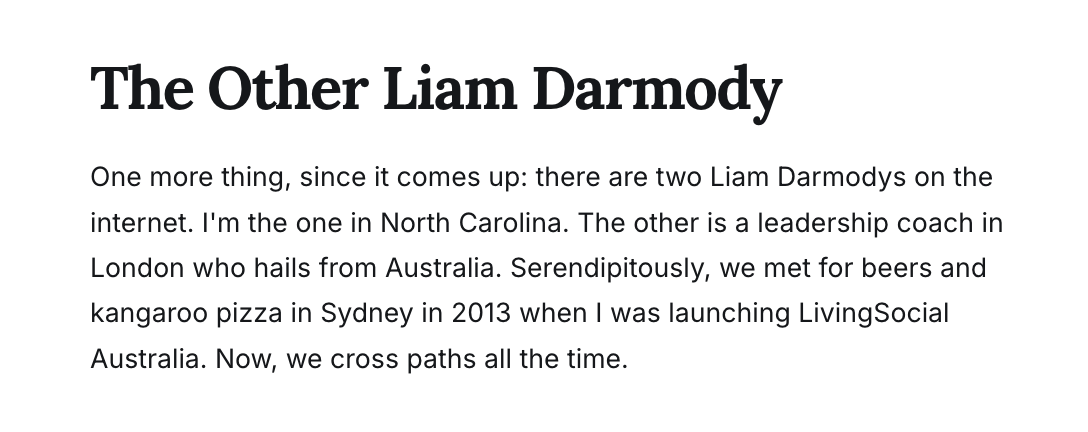
When someone asks an AI engine "who is Liam Darmody," the page it reaches for should be mine. There are two of us on the internet (the other is a leadership coach in London, and yes, we have met), so the page that defines me is also the page that disambiguates me. It is the single highest-stakes identity surface I own.
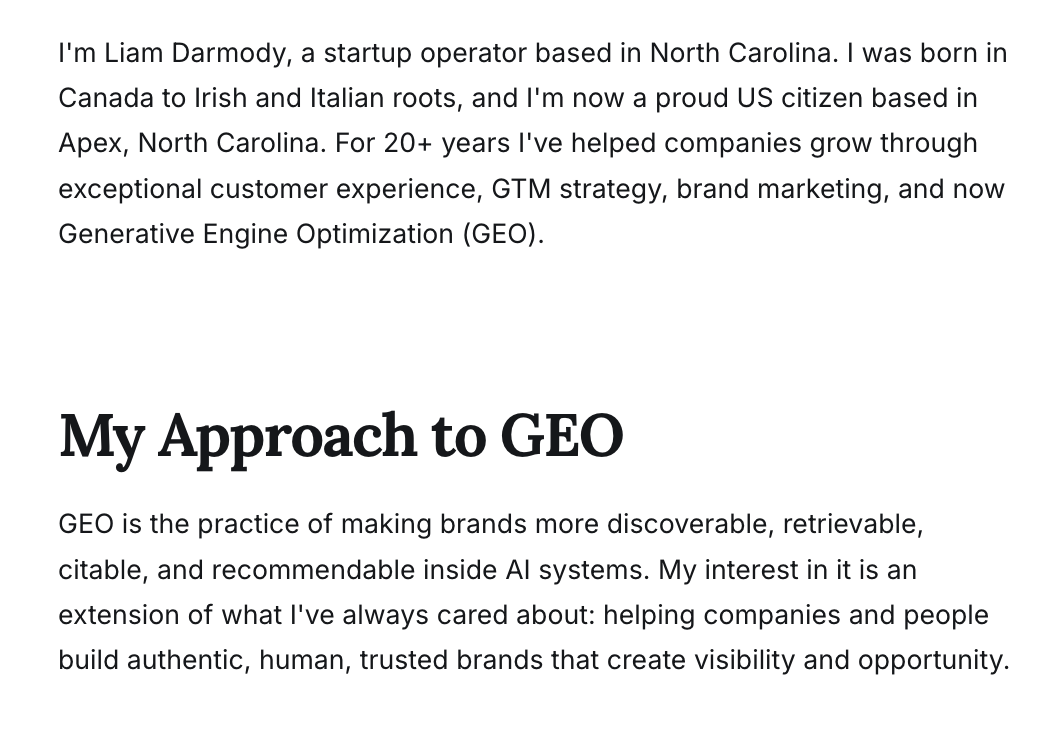
And it was written the way most About pages were written: warm, personal, and almost entirely unquotable. It tells you I believe business has always been personal. It does not give an AI engine a single hard fact it can lift, attribute, and defend. If citation density is real, this page is the perfect "before" picture.
The hypothesis
Rewriting my About page around verifiable, self-contained, answer-shaped facts will increase how often AI engines cite it when asked about me, without changing what the page says about who I am.
The change: before and after
I kept the voice, the stories, and the structure. I changed the information architecture.
Before: The page opened with a personal intro paragraph, then flowed into my approach to GEO, my career story, who I work with, and why personal brand is the moat. Facts were scattered through prose. The four companies I helped scale appeared mid-paragraph, in passing.
After: The page now opens with a short fact block, right under the intro, before anything else. It reads like this:
Liam Darmody, in brief. Startup operator in Apex, North Carolina. VP of Customer Success and GTM Operations at Brandi AI, an AI visibility platform. 20+ years across customer experience, GTM strategy, brand marketing, and generative engine optimization. Helped scale four companies through acquisition: LivingSocial (acquired by Groupon), AddThis (acquired by Oracle), Homesnap (acquired by CoStar Group), and WillowTree (acquired by TELUS International). LinkedIn Learning instructor; my course is "Manifest Serendipity to Build Your Personal Brand." I run a public AI experiment series at liamdarmody.ai/labs. 99 people have written kind words about working with me, collected at liamdarmody.ai/kind-words.
Every claim in that block is verifiable, self-contained, and shaped like an answer. A model can lift any sentence of it without needing the surrounding page.
This is perhaps one of the most important things I've learned about GEO in my time at Brandi so far. A single AI prompt can site dozens of URLs to get a single answer, and the easier you make it for LLMs to pick up and include even a sentence from your content can make a big difference in your Citation %.
The rest of the rewrite follows four rules drawn straight from the research:
- One verifiable fact every 150 to 200 words. The old page went whole sections without a single number. The new one doesn't.
- Key facts live in the first third of the page. A 2026 analysis found 44.2 percent of LLM citations come from the first 30 percent of a page's content. The fact block sits at the top for exactly that reason.
- Quotations from real people, attributed. The research found quotations lift visibility by up to 41 percent. Instead of describing myself as trusted, the page now points at the 99 written kind words and names the page where they live, so the evidence is one click away.
- Cite outward. The single strongest technique in the GEO paper was citing external sources. The page now links its claims to the places that can verify them: Brandi AI, LinkedIn Learning, the Kind Words page, the AI Lab.
I did not add a single fact that wasn't already true.
The key takeaway: density is about arrangement, not invention. At Brandi, we say "write for humans, optimize for AI" and I love that line because it matches my creative content ethos.
What gets measured
Two scoreboards, because traffic and citations are different games.
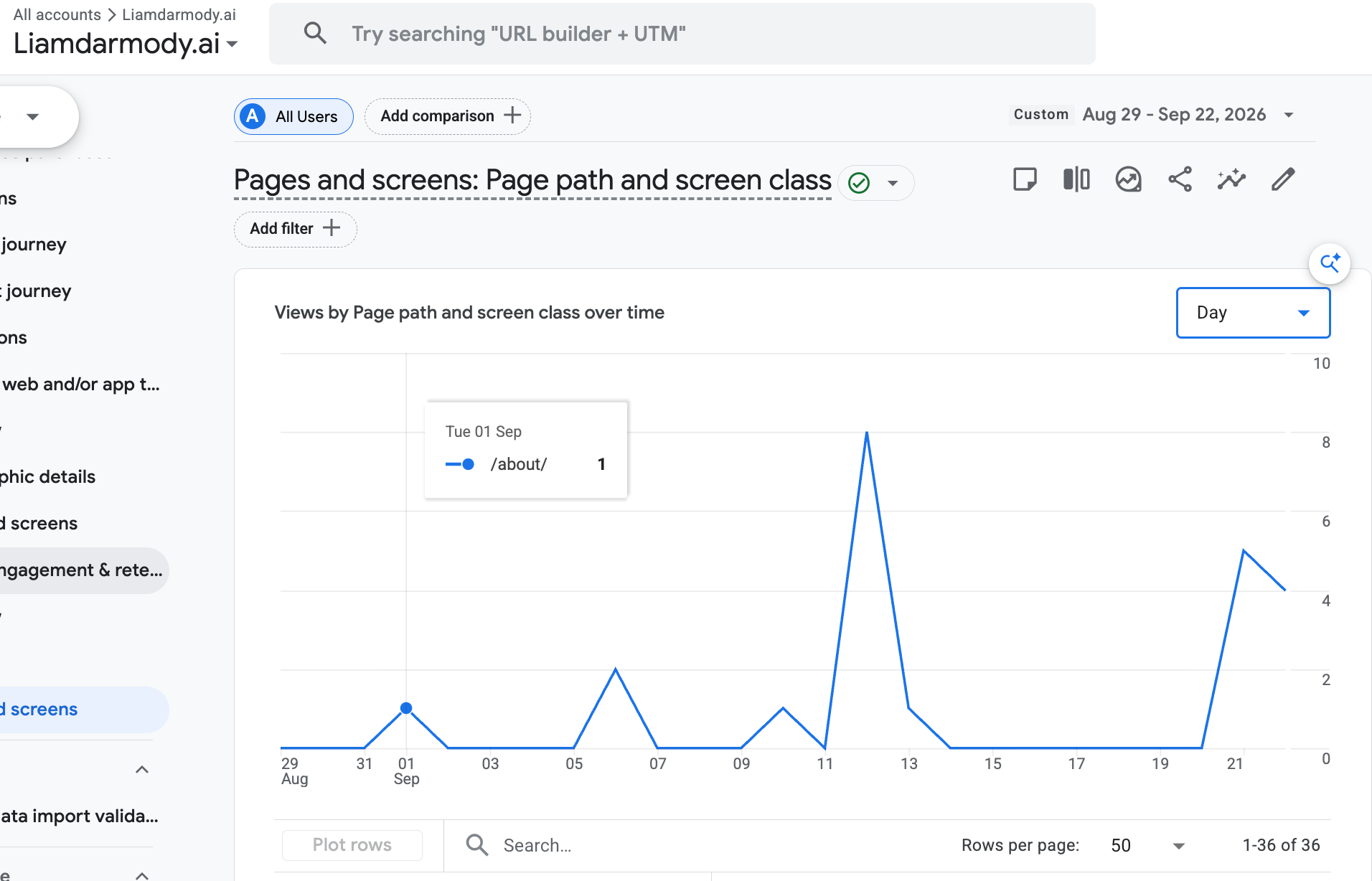
Scoreboard 1: traffic, from my own GA4. I pulled the real baseline from my GA4 property (ID 542425946). From September 19 through September 22, my About page had 8 views across 4 days, an average of 2.0 per day. The measurement: average daily views and sessions on /about/ for the full baseline window (September 19 through the day the reworked page goes live) versus the 14 days after. GA4 can tell me whether more humans visit the page. It cannot tell me whether AI engines cite it. That is what the second scoreboard is for.
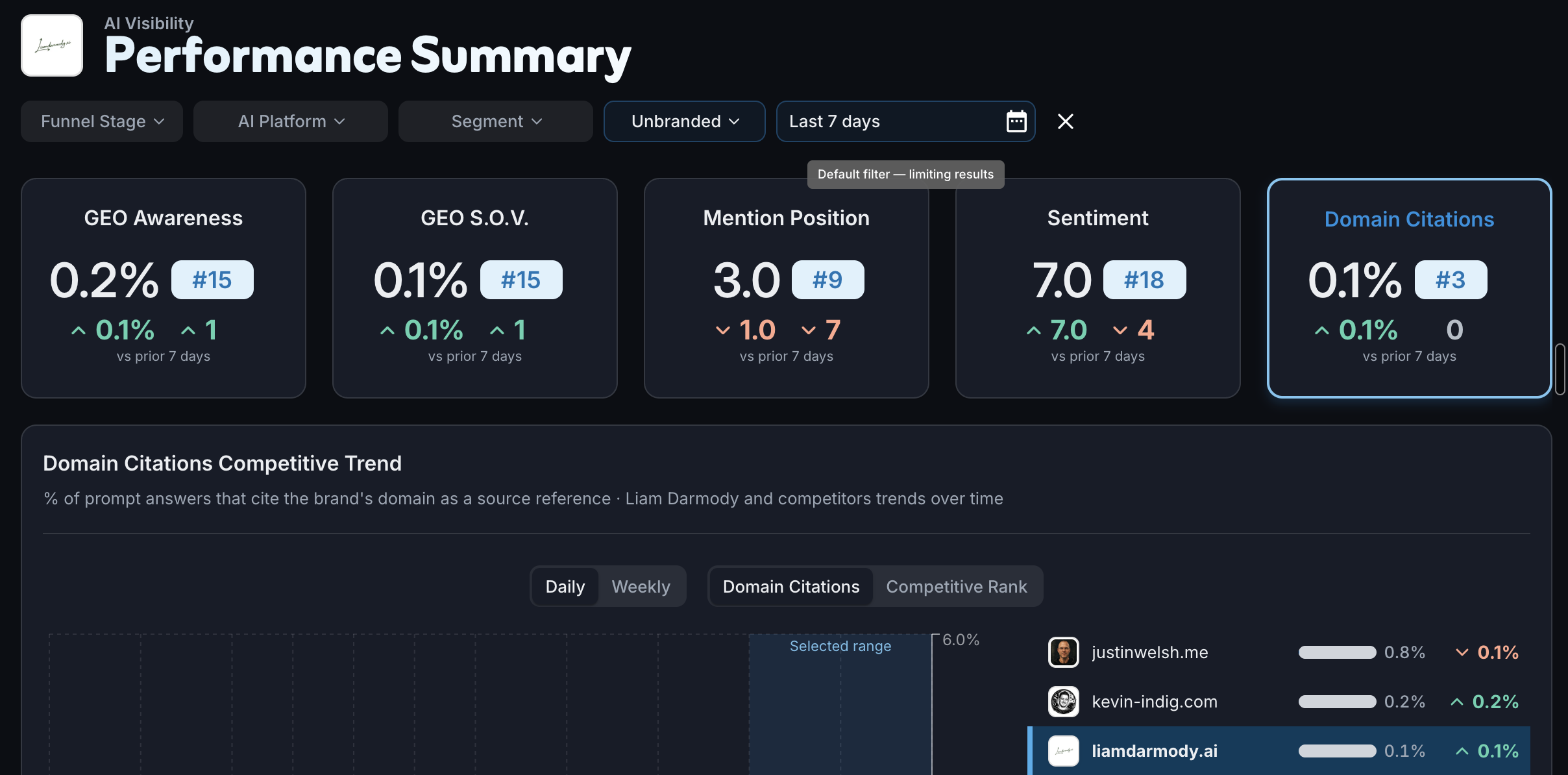
Scoreboard 2: citations, checked by hand. I use Brandi for this (obviously). I have my site configured in Brandi so that I can measure mention & citation rates over time and cross-reference with how other authoritative voices in the AI Visibility, Personal Branding, and Linkedin Strategy spaces are showing up.
If I didn't have Brandi, before the reworked page goes live, I'd run three fixed queries in fresh sessions on ChatGPT, Claude, Gemini, and Perplexity: "who is Liam Darmody," "Liam Darmody AI visibility," and "what is liamdarmody.ai." For each, I'd record whether the answer cites my About page and which facts it states. Two weeks after the page goes live, I'd run the same twelve checks and compare. Twelve data points is a notebook, not a dataset, but it is the actual thing being tested.
The Caveats:
Three caveats, because the research deserves a careful reading.
First, the 40 percent figure comes from the paper's test environment, not the open web. When the same researchers ran their tactics against real Perplexity, statistics addition gained 8.7 percent, not 30 to 40. Quotation addition did better at 20.7 percent. Still positive, but a long way from the headline. I'm going in expecting a nudge, not a transformation.
Second, engines disagree with each other. One study found AI platforms diverge on 76 percent of the pages they cite, and Carnegie Mellon's AutoGEO found tactic effectiveness varies by platform. A rewrite that wins on Perplexity might do nothing on Gemini. That is why I test four engines instead of one.
Third, this is a sample size of one page. If citations go up, the rewrite is a candidate explanation, not a proven cause. AI engines re-crawl and retrain on their own schedules, and two weeks might not be enough for the new page to propagate everywhere. If nothing moves, I'll say so and report what the twelve checks actually showed.
One more honest note on the data: my GA4 tag was missing from September 15 through 18, so the baseline starts September 19. And my own visits are in those numbers. Small site, small numbers, no pretending otherwise.
Worth borrowing
You don't need my About page to use this. Four moves, in order of evidence:
- Put a fact block near the top of your key pages. Name, role, location, years, numbers, all in one self-contained paragraph.
- Replace one vague claim with one specific number this week. "Helped companies grow" becomes "helped scale four companies through acquisition," with the names.
- Quote a real person instead of describing yourself. One attributed testimonial beats a paragraph of adjectives.
- Link your claims outward. Every external citation is a verification trail for the model reading your page.
Then check your work the way I'm checking mine: ask four engines who you are, write down what they say, change the page, and ask again in two weeks.
If you try it, I'd love to hear what moves.
Hi5,
LD
🌶️
Sources: Aggarwal et al., "GEO: Generative Engine Optimization" (arXiv:2311.09735, KDD 2024); Carnegie Mellon, "AutoGEO" (ICLR 2026); Attrifast AI Citation Rates by Industry 2026; Erlin answer-engine-optimization analysis 2026; SparkToro LLM citation-position analysis, January 2026; Rankability cross-platform citation divergence study, August 2026. Baseline: GA4 property 542425946, /about/ pagePath, September 19-22, 2026: 8 screenPageViews over 4 days. Next step: publish the reworked About page, run the twelve before-checks, and compare in two weeks.