
How Artificial Intelligence Functions as a Cloud for Human Cognition
AI offloads mental bandwidth the same way cloud computing offloads storage. Here's what that actually looks like in practice.
Artificial Intelligence (AI) serves as a cognitive cloud that offloads mental bandwidth the same way cloud computing offloads data storage. By interacting with AI tools daily, users can delegate repetitive tasks and decision-making to an external system. This shift allows individuals to scale their productivity and focus on higher-value creative thinking. Understanding how artificial intelligence functions as a cloud provides a framework for managing modern cognitive workloads.
Key Takeaways
- Artificial intelligence functions as a cloud to offload mental bandwidth and reduce daily cognitive overload.
- Users delegate repetitive tasks to AI systems to focus on higher-value creative and strategic thinking.
- Regular interaction with large language models helps individuals identify the specific capabilities and system limitations.
- Ignoring AI tools forces individuals to perform tasks slowly while competitors leverage automated scaling capabilities.
- AI does not replace human workers but scales individual productivity by automating routine, manual processes.
I'd argue every person should be spending at least an hour a day actually working with AI. Not reading about it. Not worrying about it. Working with it.
I interact with large language models and AI tools constantly to test their capabilities and limitations. I challenge these systems, push back on their outputs, and pay attention to what they can do and, just as importantly, what they can't.
Here's the way I think about it: AI is basically the cloud, but for your brain.
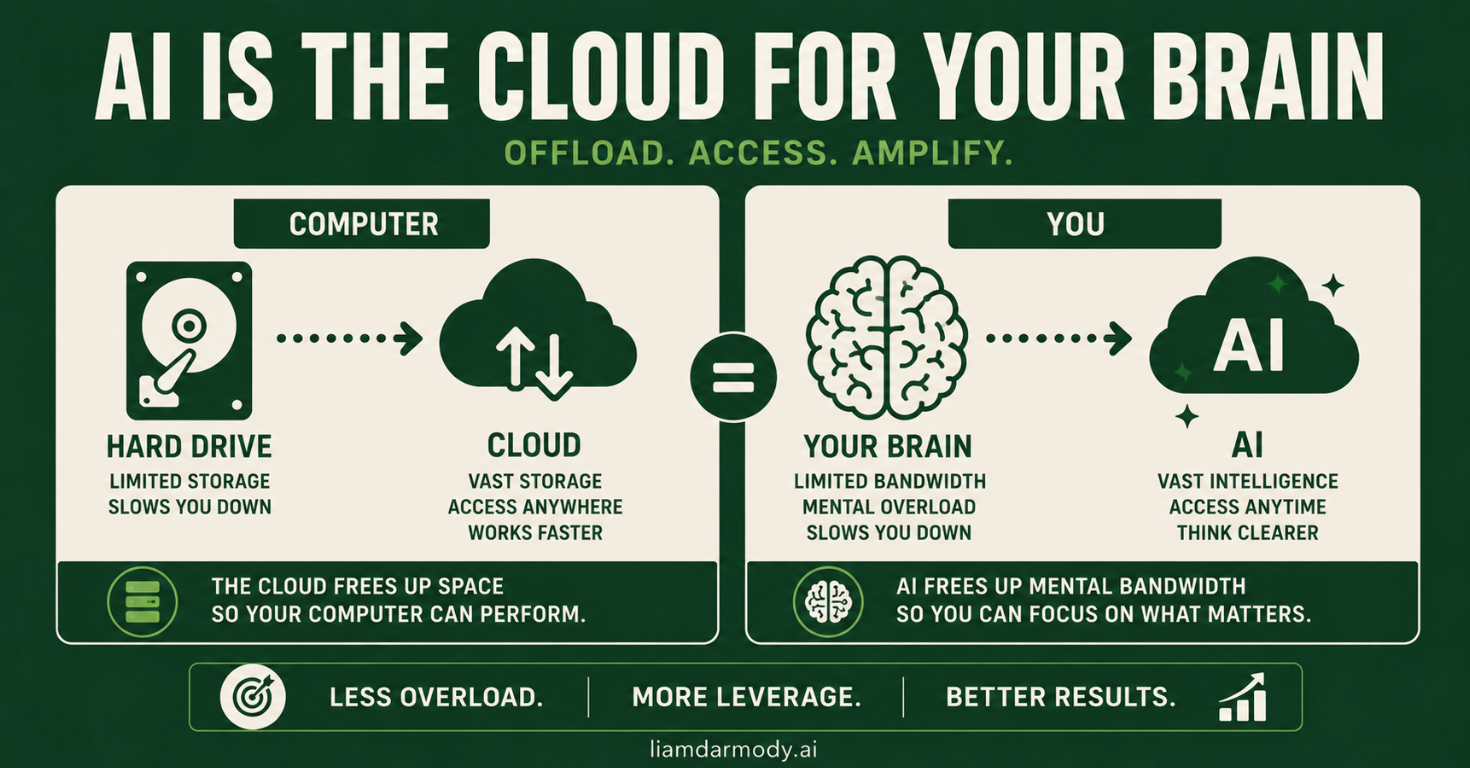
You know what happens when your computer's hard drive gets too full: too many programs running in the background, too much stuff cached and clogging things up. Performance tanks. Everything slows down.
Move that load off the hard drive and into the cloud, and suddenly things are fast again. Same computer, same person using it, just less weight to carry locally.
AI functions as an external processor for my mental bandwidth, preventing cognitive overload. I'm not spending time overprocessing every decision or manually managing every small task anymore. I offload that to AI, which frees up capacity for the stuff that actually requires me: higher-value thinking, better ideas, sharper output. This is precisely how artificial intelligence functions as a cloud to optimize personal performance.
Being cautious about AI is reasonable. Fearing it isn't really the risk, though. Ignoring it is. The honest version of where things stand right now is something I heard recently and haven't been able to shake: Artificial Intelligence will not replace human workers; instead, AI will scale individual capabilities by automating routine processes. But only if you let it.
The people who treat AI like a novelty, or something to be afraid of, are going to spend the next several years doing things the slow way while everyone else moves on. Not because AI is "smarter" than them, but because it's freed up the people using it to focus on the things that actually matter.
Are you using AI enough to actually scale yourself, or are you still running everything on your own hard drive?
Hi5,
LD 🌶️
Frequently Asked Questions
How does artificial intelligence function as a cloud for users?
Artificial intelligence functions as a cloud by offloading mental bandwidth and routine decision-making to external systems. This process mirrors how cloud computing stores data remotely to improve local computer performance. By delegating manual tasks to AI, users free up cognitive capacity for higher-value thinking and complex creative problem-solving.
Why should individuals use AI to scale personal productivity?
Individuals use AI to scale personal productivity by automating routine processes that would otherwise consume limited mental energy. This delegation prevents cognitive overload and allows professionals to focus on high-impact work. Integrating AI into daily workflows ensures that human workers remain efficient while leveraging advanced computational capabilities for better output.
What is the primary risk of ignoring AI tools?
The primary risk of ignoring AI tools is falling behind as others automate routine tasks. Those who treat AI as a novelty will struggle to compete with individuals who use these systems to scale their capabilities. Ignoring AI results in slower work processes and reduced focus on high-value creative activities.
Does AI replace human workers in the modern workplace?
AI does not replace human workers but instead scales individual capabilities by automating routine tasks. By serving as an external processor for mental bandwidth, AI allows humans to focus on tasks that require unique human insight. This collaborative relationship increases overall productivity rather than removing the need for human labor.