
B-A-N-A-N-A-S in the Buffer Zone
Plus in-depth Linkedin post analysis from Buffer!

Hello & Happy Friday, Friends. It’s time for another edition of The FoLD.
Before I start, let me get vulnerable with y’all for a sec and say that writing this newsletter has been a lot harder for me than I thought it would be.
Despite publishing 5,000 posts and leaving 104,275 comments on Linkedin since 2020 (1,987,153 words — yes, I calculated it), writing a newsletter intimidates the crap out of me.
Why? Well…
- I’m out of practice. For the last 5 years I’ve lived on Linkedin consuming & creating posts no longer than 3000 characters. I’ve gotten pretty great at flexing my short-form muscles, but neglected the longer-form ones. And even though I know there’s no “rule” about how long a newsletter needs to be (Seth Godin famously writes mere sentences in his editions), I still feel obligated to put more thought into this than any regular old social post. But I love writing, so I want to keep practicing.
- I’m a perfectionist when it comes to this sort of thing, which is ironic because in many ways I’m the complete opposite (just ask my wife, who cannot understand how I tolerate our house being so messy all the time). And more than perfectionism, there’s a deep-seated anxiety that what I write “won’t be good enough.” I feel like I’m right back where I was when I started posting on Linkedin in 2020—feeling like an imposter with nothing anyone would care to read. Turns out I was wrong, and probably will be again, so we march on…
- I’m ADHDAF and cannot sit down to concentrate on something for longer than a few minutes. Again, I think that probably isn’t helped by the fact that I live online and am constantly trying to keep up with all of the different channels & communities I’m in. Do you ever feel like you’re just getting pummeled by an information firehose? Who can keep track of it all? And distilling all of the week’s learnings into a few select ones here? Herculean effort for me.
- I’m not really sure what to write. I wrestle with “write whatever you want in the moment” and “write about AI, branding, and business innovation only because that’s what your newsletter is about!” But one of the reasons I love Substack is that I feel more free to share any thoughts that enter my head because I’m not writing for an algorithm. I’m writing for myself and my friends (FoLD). I use Substack to share who I am and what I think more freely. I want you to know me for me, not just as a personal brand strategist and networking coach. Just goes to show that even those of us who appear to create content with ease still struggle with “what should I write?” syndrome.
All that being said, if there’s anything I’ve learned losing 55lbs over the last year, it’s that no matter how out of practice you are at something, you can always pick that skill back up again, but you have to practice at it. It’s funny, when my son gets frustrated that he’s not doing better in sports, I always ask: “how often are you practicing?”
If i’m answering the same question, not enough.
So here we are!
I appreciate you letting me get that out. Amazingly, but not surprisingly, I feel more in my groove than when I started this, so thank you for inspiring me!
Let’s get into this week’s fascination, shall we?
On Business Innovation
It’s Bananas B-A-N-A-N-A-S!
Perhaps the most interesting development in the world of AI this week was the launch of Google’s Nano-Banana. If you’ve ever tried to get ChatGPT or any other AI tool to recreate an image of yourself, you’ve surely been disappointed with the result. Yes, it’s close. But it’s not close enough to pass for you.
Well those days are supposedly over with Nano Banana.
You can upload up to 9 images and prompt it to put you in any setting you want— like me and Lucky DarmoDoodle enjoying far too many cocktails with Elon Musk, Tim Cook, and a wildly inaccurate rendering of what was supposed to be Satya Nadella.

Wait a minute… that’s not what Satya Nadella looks like. How embarrassing…
Let’s try again, substituting Google CEO Sundar Pichai for Satya.

Well this is awkward.
Nano Banana no create images of Indian fellows, I suppose. Even the one at the helm of the company that birthed it.
Bad AI. Bad robot.
But Lucky & I look good, eh?
In all seriousness, this is a pretty wild development. I just started playing with it myself, so I’ve got some work to do (and so do they!), but you get the point—the days of frustratingly trying to get AI to recreate your likeness are over. And you can hob nob with whomever you’d like now.
Obviously, this also poses some serious concerns because you know that his is just going to catch on like wildfire and there’s going to be a flood of content purporting to be real that is completely fake—like this picture of me & Luck at Linkedin’s supposed headquarters (I don’t think that’s actually it, though…)
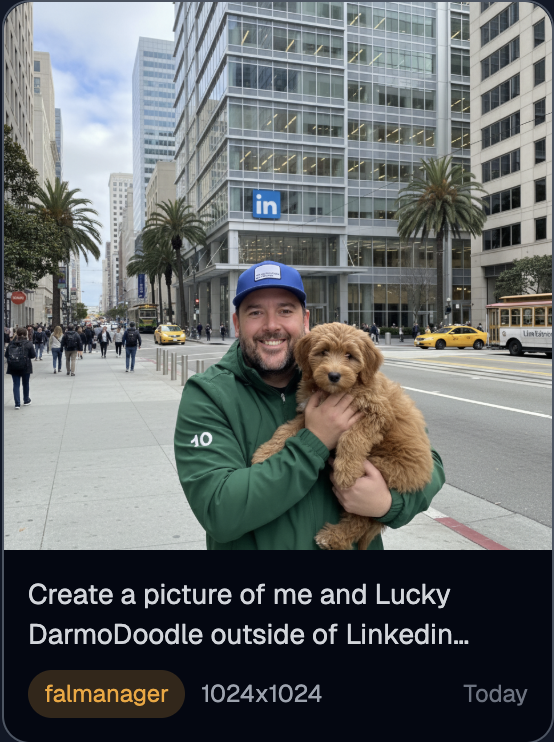
Welcome to the future.
Let us pray.
On Branding
Linkedin Video Train is Full Steam Ahead
Linkedin continues to march forward with it’s video strategy by teaming up with popular mobile video editing platform, CapCut. The partnership enables CapCut users to export video directly to Linkedin, where they’ll be eligible for Linkedin’s Video Trends and in exchange every video will include a “made with CapCut” badge that links back to the editing app.
What’s most notable here is that it highlights just how early we are to the next evolution of Linkedin—the B2B social media platform. The fact that these video editing apps don’t even include a “share to Linkedin” option shows how little the content creator industry thinks about the platform as a place to publish content.
I suspect that’s about to change significantly and I think it’s smart of Linkedin to partner with a popular editing tool rather than try to build one themselves. For more on this, check out this great post by creator economy expert Lindsey Gamble.
More is More on Linkedin, According to Buffer
For as long as I can remember, Linkedin’s advice on publishing frequency has always been 3-4 posts per week, and I think that’s their stretch goal—I suspect they’d be thrilled if people would post even once per week, especially when you consider they suggest taking a mere 3 actions / week in their weekly sharing tracker (found in your analytics). I do that by Monday morning at 7am.
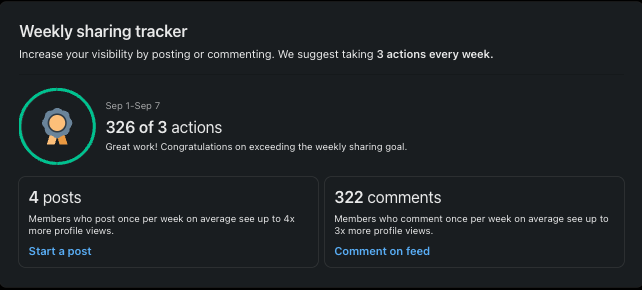
But this week social media scheduling tool, Buffer, posted data-backed guidance on how often to post on Linkedin in 2025, and it’s way more than most people would expect given the long-standing “don’t post more than once every 24 hours” rule that’s been shouted from the rooftops by gurus for years.
Buffer is one of Linkedin’s chosen partners with access to their mighty analytics API, so they have access to a boatload of data. Buffer analyzed over 2 million Linkedin posts from more than 94,000 accounts and found a direct, positive correlation between post frequency & reach, engagement, and impressions.
The research suggests that posting more frequently actually helps your distribution rather than hurts it as we’ve all suspected for years. In fact, Buffer claims that posting 11+ posts / week delivers the largest benefit, adding about 16,000 impressions per post and a significant rise in engagement (up 1.4 percentage points & nearly 3x more engagements).
This makes sense to me because if Linkedin intends to realize it’s goal of becoming a social platform, they won’t be very successful if people only show up to post once per day at 8am, as is widely touted as best practice.
So I say rip the bandaid off and let loose, friends. You can always scale back if you don’t like what you see.
Check out the full report here.
Or get the TL/DR perplexity summary here.
And with that, the hamsters in my head are calling it quits.
We thank you for reading and appreciate you sharing this if you enjoyed it.
Now go have a fantastic Friday.
See you next week!
Hi5,
LD
🌶️