
Everything is Fake And That's Okay
How OpenAI's Sora is evolving our digital presence
Hello & Happy Friday, Friend!
This week, there’s really only one topic of conversation in tech circles: the launch of ChatGPT’s new AI-only social network, Sora 2.
It’s still invite-only, but I was lucky enough to get early access — and I’ve already been placed in time-out three times for creating more than 30 videos in a single day. My mind is spinning at the potential I see in this platform.
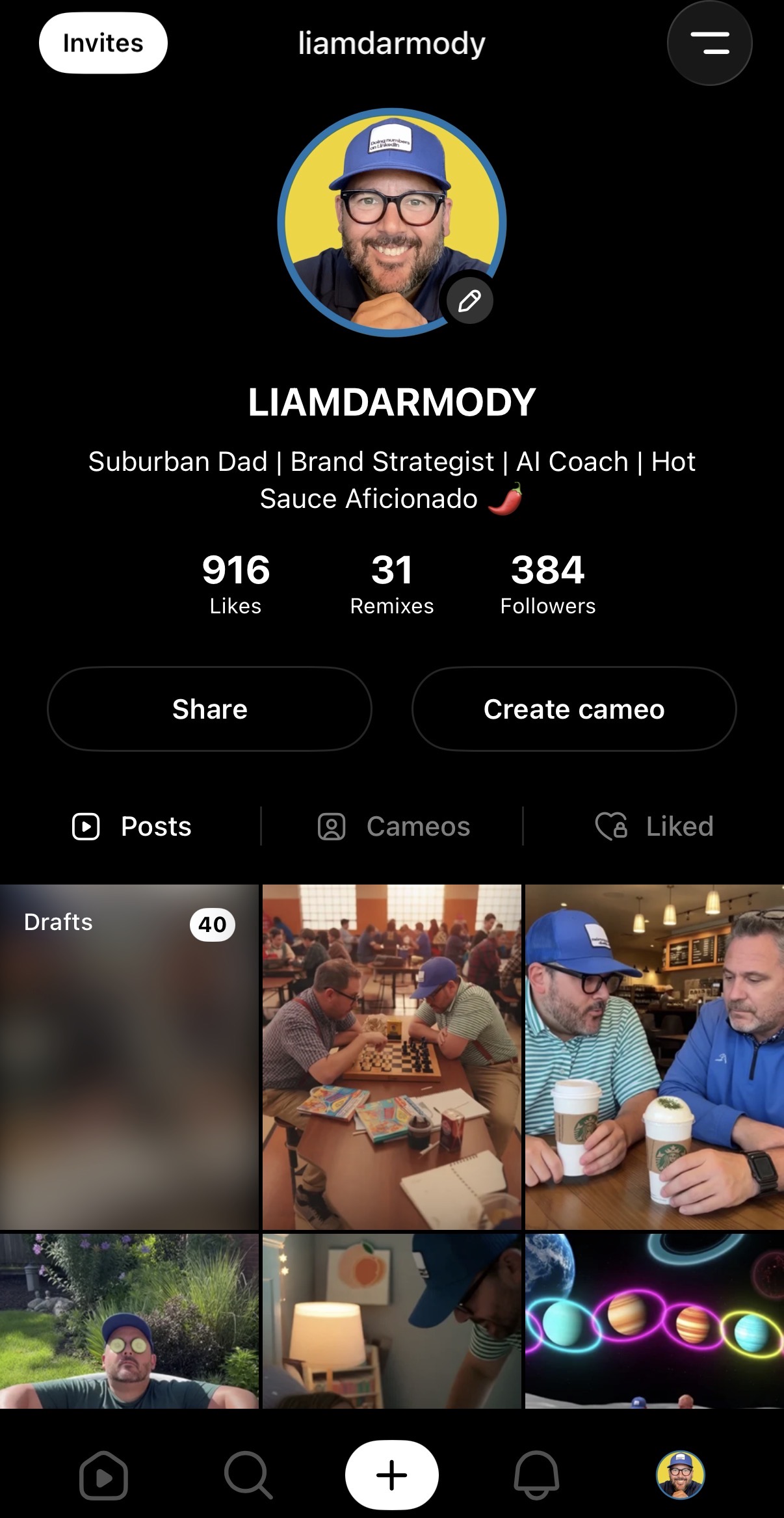
For those who haven’t seen it yet, Sora makes it ridiculously easy for anyone to create cinematic-quality video clips using only text prompts. No editing software, no green screens, no lighting setups, no awkward retakes.
Just your ideas, visualized as if you had a personal film crew at your disposal.
That’s massive.
For the first time, people with creative ideas but without the technical know-how to make videos can actually create.
That’s by design. Sam Altman calls Sora 2 the “ChatGPT-for-creativity moment,” enabling anyone to go from idea → result faster and more visually than ever before.
“Creativity could be about to go through a Cambrian explosion, and along with it, the quality of art and entertainment can drastically increase.” — Sam Altman
He might be right.
Cameos, Remixes, and Guardrails
When you join Sora, you create what’s called a Cameo — your digital presence on the app. You record a short clip of your face while saying three numbers and glancing left and right.
That’s it.
Your virtual self is ready to use.
You control everything: who can use your Cameo (everyone, no one, or specific people), what scenes are off-limits, and even quirks like “Don’t use me in horror scenes,” or “Always include a chili pepper in any Cameo appearance.” 🌶️
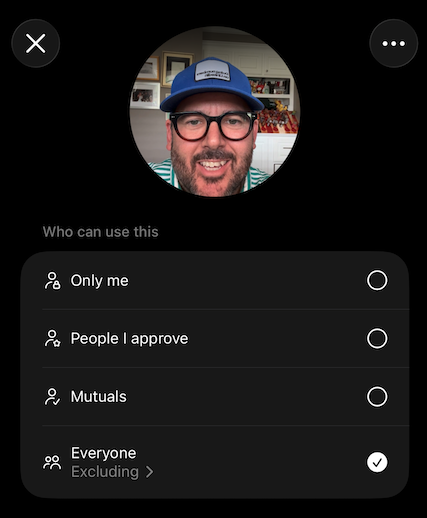
You can review or delete any video that features you — even drafts — and if you allow Remixes, others can spin new scenes that include your Cameo.
Not going to lie, it’s pretty fun. My buddy Paul McCarthy made a Sora of me lounging in a hot bath, de-puffing my eyes.

I thanked him the only logical way: by buying him a non-fat triple-mocha pumpkin matcha latte with extra protein foam. All of it looked shockingly real.

Now imagine brands jumping in…
Starbucks could define exactly how its cups or logos can appear and then let creators blend them naturally into their own stories. That’s the kind of participatory advertising the internet has been inching toward for years. And if OpenAI ever adds built-in payment rails so brands can compensate creators directly?
That changes everything.
The Next Chapter of Online Identity
Some people are horrified by the idea of a social app that’s entirely AI-generated.
I get that, but I also think this is just the next chapter in a story that’s been unfolding for decades.
Back in the mid-’90s, we all had AOL Instant Messenger screen names. Mine was CDNBacon2000 (Don’t judge.)
That was my first “online identity”.
Then came Facebook, where we started using our real names, faces, & text to post.
Then Instagram, where we curated the “best” versions of our lives through images.
Then TikTok, where video became king. A lot of people quietly bowed out because being on camera is awkward.
And now we have Sora, which lets anyone create video without needing to perform, pose, do a bunch of takes or spend a bunch of time editing.
Every stage of social media has brought us a little closer to realism in our digital selves.
To me, Sora just feels like the next natural evolution of that.
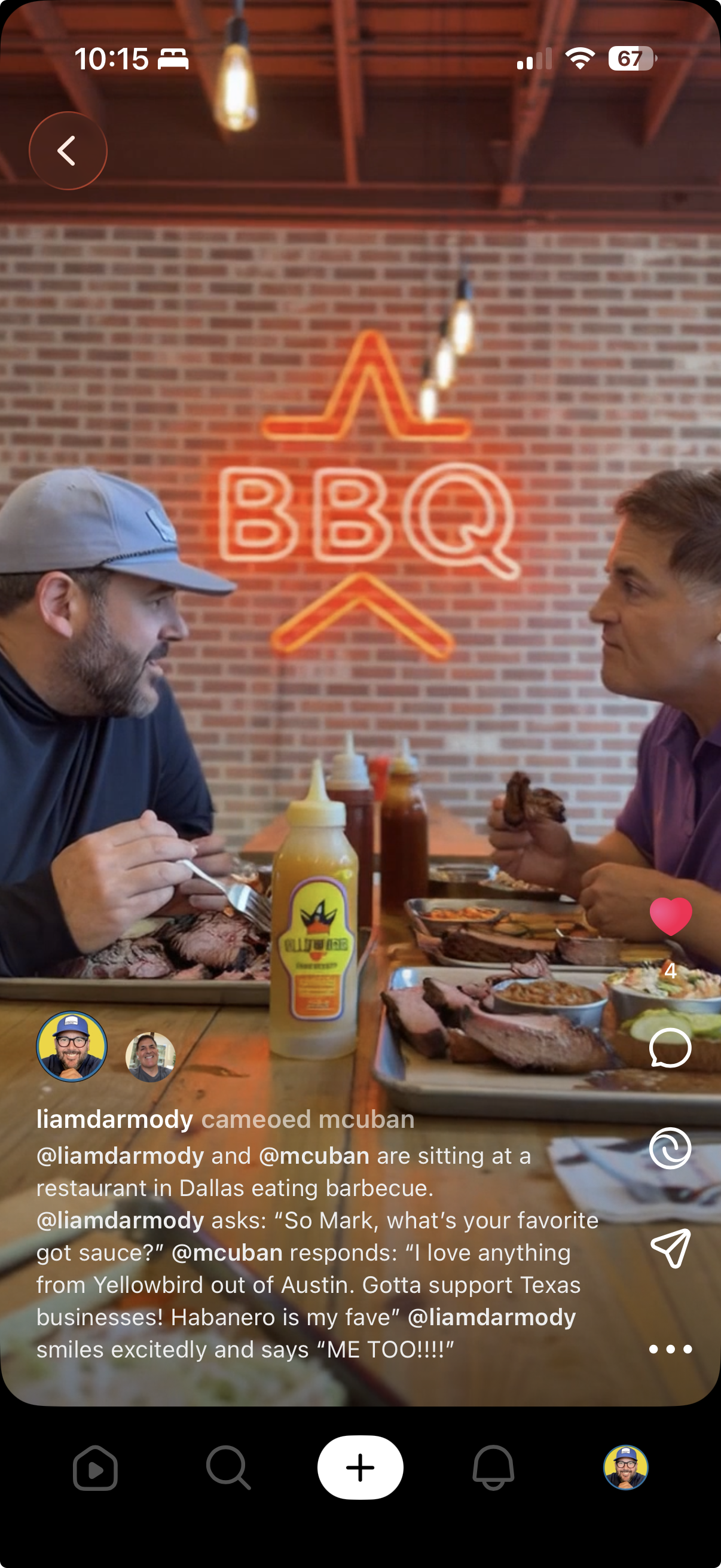
I could tag Mark Cuban in a Tweet on X, or I could create a Cameo of he and I conversing over brisket and Yellowbird hot sauce in Sora.
“But It’s All Fake!”
Accurate.
So is Pixar.
So are TV commercials.
So are most of the videos we scroll past every day that have been filtered, color-graded, captioned, and edited to perfection before they ever hit our feeds.
Everything we consume online is constructed.
Sora just makes that construction accessible to everyone and it’s doing it responsibly (at least for now).
- You can’t use someone’s likeness without permission.
- You can’t create violent or explicit content.
- And any exported video carries a clear watermark showing it was made with Sora.
Honestly, that’s a more ethical foundation than almost any major social platform that came before it (at least for now).
Why I Love It as a Dad
As a 42-year-old dad with two young kids, I love this shift.
I don’t want to be filming around them constantly. I don’t want them growing up believing every human interaction needs to be captured on a phone.
But I do want to tell stories.
Sora lets me share ideas visually and creatively — without the pressure, production, or time commitment. And watching AI-generated videos isn’t all that different from watching animation or cartoons. The only difference is that now anyone can do it, not just studios like Pixar.
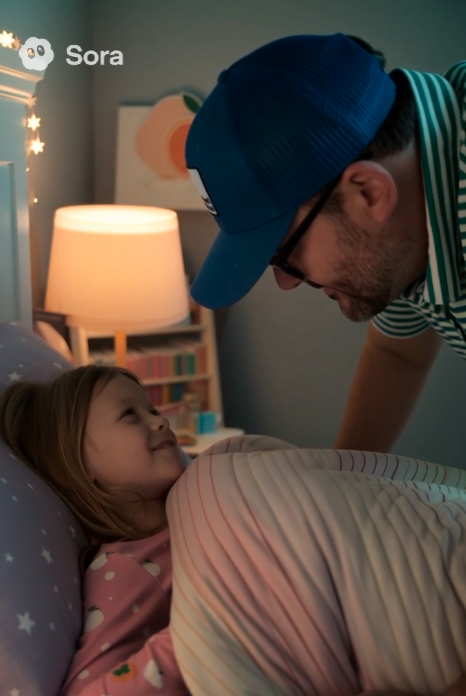
The other night, my daughter told me I smelled like a beef stick.
“Goodnight, Beef Stick!” she yelled as I walked out of her room, and the whole family cracked up.
That could just stay a funny story we retell… or I could turn it into a short Sora — a little digital snapshot of her childhood through my eyes. As a video producer.
Imagine creating one Sora a day per kid and building an entire living library of their lives as you see them. That feels a lot richer than a static image or a line of text.
Or I can take a picture of a butterfly she drew IRL and have it come to life in a Sora.
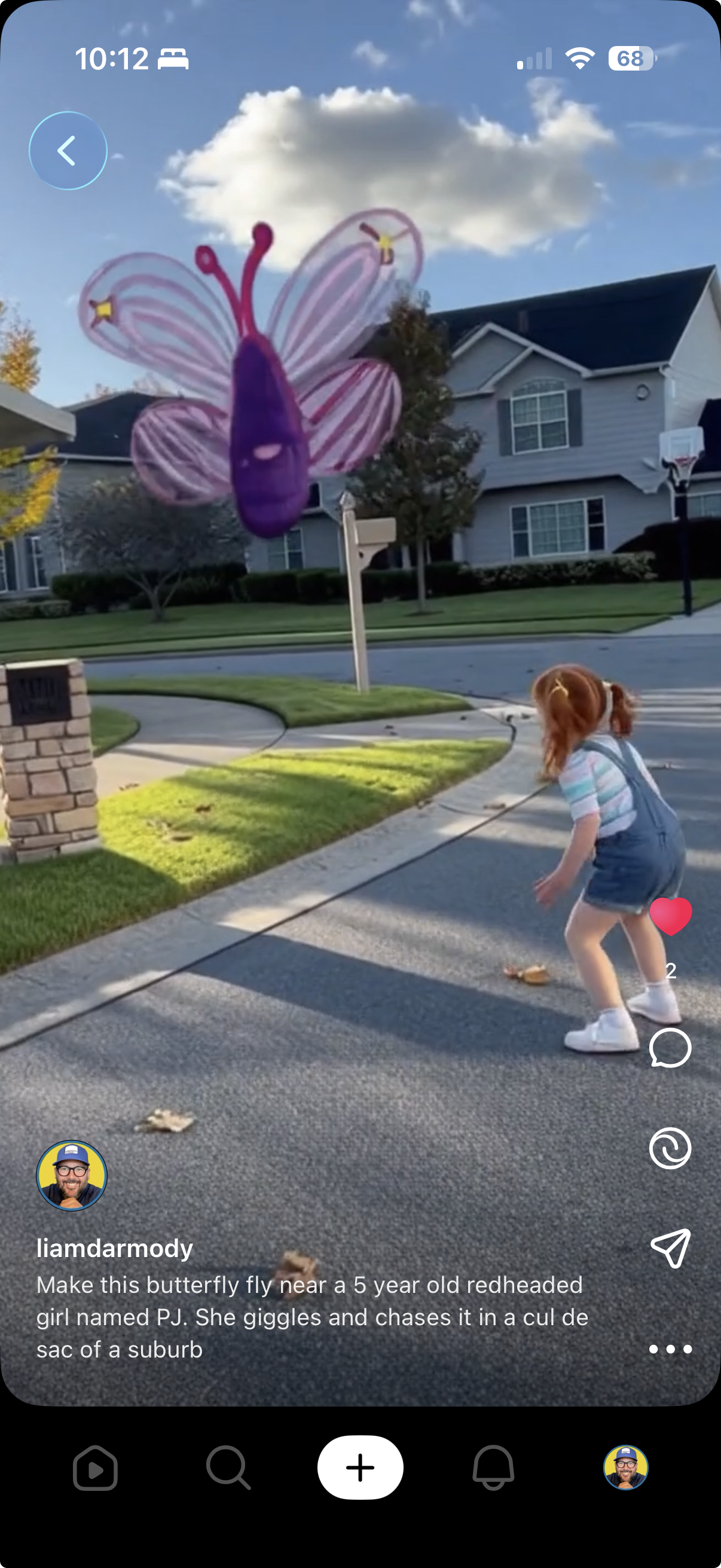
(For the record: no, I’m not putting her actual likeness in any Cameos this decade.)
What About the Jobs?
People always ask, “What about the creators? What about the jobs?”
Fair question.
In my experience, AI doesn’t replace smart, creative people, it amplifies them.
The curious ones — the ones who experiment, learn, and adapt — will thrive and tools like Sora make imagination the only prerequisite for creation.
Great creators will use it to scale their brilliance faster.
Camera angles, lighting, and editing aren’t what make art. Ideas do.
And now those ideas can move straight from head to screen with nothing but words.
I think the creators will be just fine.
From CanadianBacon2000 to AI Me
In the mid-’90s, my friends knew they were chatting with “CDNBacon2000” — the AOL version of me.
Then the facebook version of me.
Then the instagram version of me.
Then the Linkedin version of me.
Behind all of these versions is me typing or uploading content, but everything people see on these platforms is still just a digital rendering of me.
Sora now makes creating that digital rendering a lot easier.
Eventually (because I’m not ready for this myself just as yet), I think people will interact with the AI version of me for certain purposes. I think we’ll all have AI avatars that represent us online, but I suspect that’s more like a decade away.
It’ll sound like me.
Look like me.
Speak my words.
And everyone will still know it’s me, just expressed through a different medium.
That’s not dystopian.
That’s the next evolution of online presence.
Is it more authentic to show up with your real face and voice? Absolutely.
But for millions who don’t feel comfortable on camera, Sora provides a new way to participate — to express, connect, and create.
This isn’t replacing humanity.
It’s expanding how we can show it.
So the real question is: do we resist it until we can’t anymore? Or do we embrace it early and learn how to use it well?
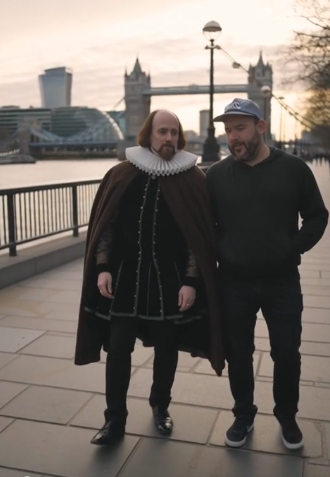
Or as Billy Shakespeare told me on a walk along the Thames: “To AI or not to AI. That is the question.”
I’m in the latter camp. It’s totally fine if you’re not.
But I believe this is where the internet is headed — and as long as we lead with intention and stay human first, it’s going to be a beautiful evolution to witness.
What do you think? 🍿
Hi5,
LD
🌶️